


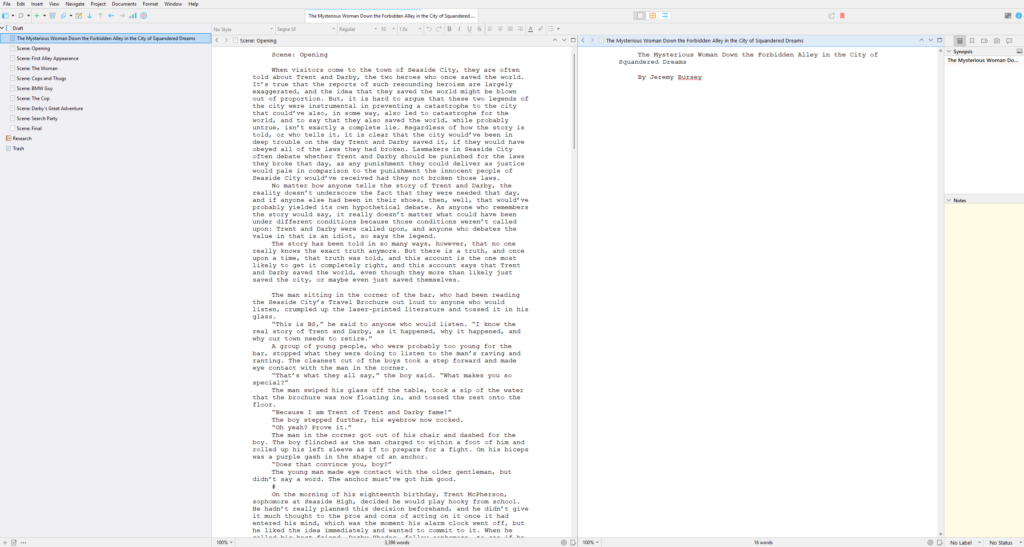
I’ve been participating in the annual 30-day novel writing event called NaNoWriMo (and its 2025 successor, Novel November) since 2017. That first year, I opened Scrivener, started typing the first chapter to the novel I’d been dreaming about each time I’d pass a certain alley on my frequent walks to the beach, and felt a sense of accomplishment when I’d reached the end of that first day a success.
I’d tell you how many words I wrote on that first day if I could, but I’d given myself no checkpoints within that first chapter or scene to mark the end of my session’s progress, and the official NaNoWriMo site where I had recorded my daily progress has since been taken down due to scandal.
But I can tell you I ended November 2017 with over 34,000 words toward the thriller that was also supposed to be a comedy but didn’t end up being that funny. The novel, called The Mysterious Woman Down the Forgotten Alley in the City of Squandered Dreams, is based on the idea that the alley I’d often passed on my way to the beach was housing a secret entrance to an underground bunker that led to a network of shadow conspiracies and weapons of mass destruction, and the way in was through selective invitation by the mysterious woman in red. In the novel, my main characters, Trent and Darby, are Bill and Ted-level slackers who skip school on the day they’re lured into this alley by this woman. Comedy and suspense would soon follow.
Weirdly, I never got them to that point. I’d spent so much time setting up an aboveground conspiracy that I never quite got them below ground. Realizing the spaghetti-style mess I was making by keeping them from the only plot point that was supposed to matter led me to a stall in momentum. To this day, the story still sits at just over 34,000 words. I’ve had other novels to finish since.
In November 2018, the NaNoWriMo event came back around, and this time I was determined to get even closer to the month’s collective target of 50,000 words. So, I once again opened a new file, this time in Microsoft Word, wrote the first scene to my newest project, Hurricane Rick, finished the scene with just over 2,300 words, tapped my fist to my shoulder for such an excellent opening (where the news is on TV and reporting unimportant events, but no one is watching except for the cat), and then let the rest of the month slip by without another word.
The good news is that I could tell you exactly how many words I wrote that first day because it was all I wrote for that novel. But if I had kept going, I’m sure the records would once again get buried by scandal.
With two November-launched works now started (one in Scrivener and one in Microsoft Word), I had a good system for writing, but my system for tracking word counts was terrible. I’d have to jump onto the NaNoWriMo website each night before midnight to ensure I got my day’s word count logged in and counted for the correct day. Otherwise, my daily progress chart would go from looking like a fun rollercoaster to a terrifying one.
I don’t recall if part of my reason for bowing out of the 2018 event so suddenly was due to this rush to log my word counts before midnight via a system that took extra work to ensure accurate reporting, but it sure didn’t inspire me to stay on. I knew that if I came back to the event the following year, I’d want a better tracking system, and maybe a better means for converting my story into a story project.
NaNoWriMo Basic Template for Scrivener: The Beginning
So, the following year, in October 2019, I had an idea for a pirate novel that I’d plotted in my head from beginning to end while taking a shower. As soon as I got dressed, I got to my computer and mapped out the story’s events so I wouldn’t forget them. At some point, I’d even decided it would be an in-universe megaprequel (a story taking place so long before the main story that it doesn’t seem to belong to the same universe, much less the same story) to my superhero series A Modern-day Fantasy, taking place over 250 years before the events of Cannonball City.
But when would I start writing it? Would I drop everything I was currently writing to give this new shiny object a chase? Would I be grateful for the complete layout of the idea but decide to work on it much later whenever I’d have more time to think about it?
Or would I just decide to make it my 2019 NaNoWriMo novel?
The answer to the last question was yes, and on November 1, 2019, I started writing the opening scene to Washed Up: A Pirate Adventure, a story that introduces us to an enemy force that would one day become an A-tier enemy in the A Modern-day Fantasy storyline, the Raiders of Calamity.
But before I wrote that first scene, I had to decide how I wanted to write it. I knew I wanted to track my word count and post it accurately on the NaNoWriMo website each night before midnight. But I didn’t want to go through the laborious act of highlighting a chunk of text and picking the word count out from a small counter each time. I wanted a system that would track my word count accurately at just the press of a button while still maintaining a system of records, planning, character development, etc. outside the story but within the project ecosystem.
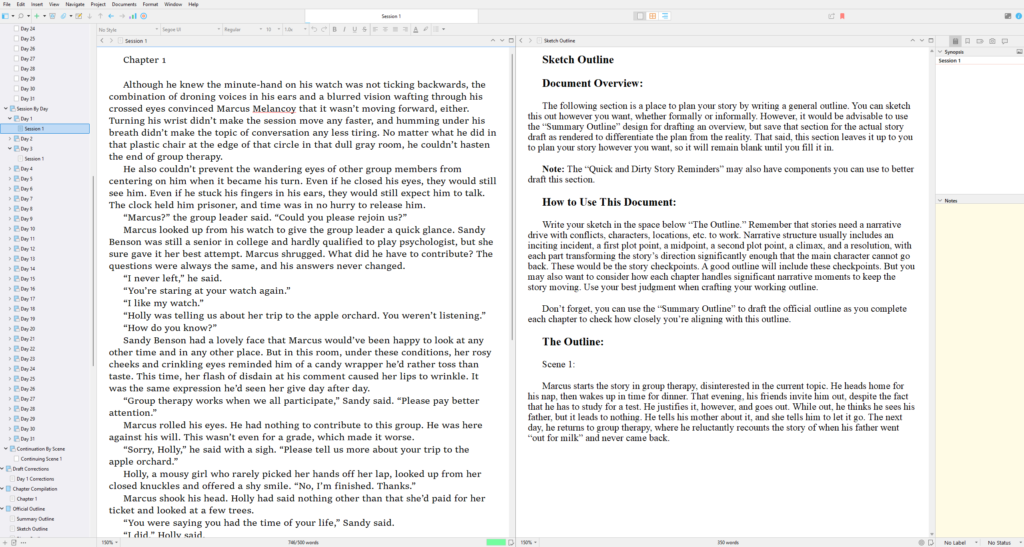
Fortunately, I knew Scrivener had that ability, so I decided to build a basic template that would make tracking my word counts easily. While I was at it, I figured I’d also add a few pages to the template that could give me a place to record my story notes. I called it the “Quick and Dirty Story Reminders.” This is what I’d use to record my character, scene, and location notes. Because I was using Scrivener, I wouldn’t even need to open a new document to read it. I could just leave it open in the window opposite my draft.
But even more important than creating story tracking templates was the “Tracking Elements” page, where I would store a mini-record of progress throughout my month-long writing journey and write a few experience notes about it. It was here that I would log my daily progress and compare it to my goal for that day. I would also have a place to record my word count for the novel so far, so I could keep an eye on how close I was to the 50,000-word goal. This also made it much easier to jump onto the NaNoWriMo website before midnight and record transcribe my word count for the day. I had so much momentum this time that I not only reached the 50,000-word target, but I exceeded it by over 10,000 words.
I also never finished it, but that’s another story for another day.
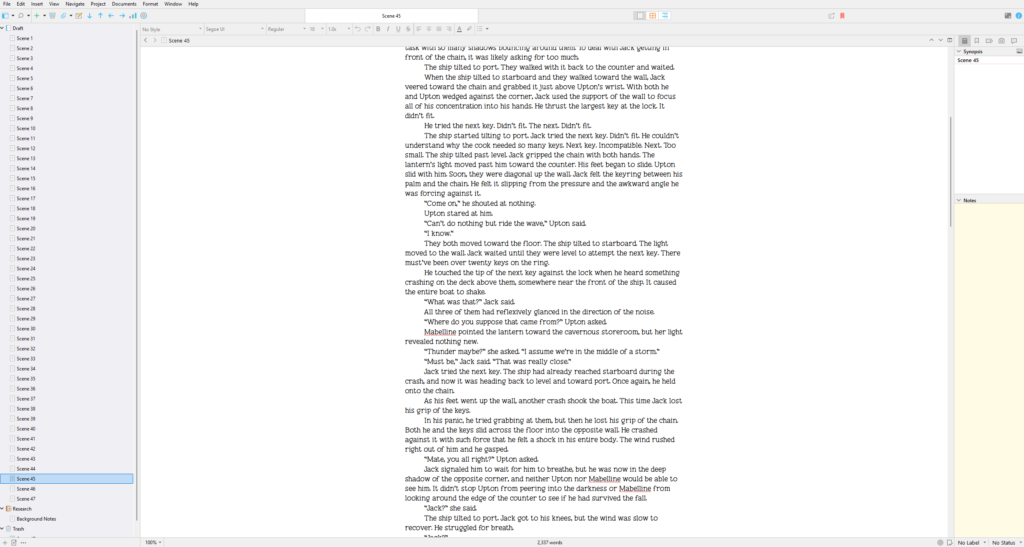
A scene from a writing software interface displaying a draft of a story featuring characters named Jack and Upton.
I reused this new “NaNoWriMo Basic Template for Scrivener” again in 2020 to draft my thriller Nice and Legal, again hitting over 60,000 words and again never going back to it but to finish a couple of scenes (it’s closer to 70,000 words out of a projected 100,000 words now), but I couldn’t help but wonder if the template could’ve offered more incentive to stick with the story beyond November 30th.
Part of the issue was that I didn’t want to tread on my month’s word count statistics. I was proud of crossing 60,000 words both times, but I didn’t want to erase them from the record by adding more scenes to the draft file. So, in 2021, the year I started on my currently unfinished domestic thriller Next in Line, I set up the next system to help me move my stories out of the NaNoWriMo template and into a new draft where I could compose the story in chapters instead of “days.”
This system involved tagging and labeling my scenes with clear records of progression. If the scene was in drafting mode, I’d label it as such. If it was ready for revision, I’d tag it with the appropriate label. The premise behind this new system was that I could track the state of each scene to know when it was ready to move off the template and into a Microsoft Word file or separate Scrivener file for further development. With this system, I could preserve the NaNoWriMo version while having a means to finish the story my own way.
It was a good idea in theory, but it kept the problem that I’d have to move the story to finish it. It was a problem I would solve two years later with one system and three years later with another, but for now, it was a solution to a problem that had kept my stories bound to their “day” sessions regardless how many scenes or chapters I might’ve written.
The other issue I was up against, that neither 2019 nor 2020 had addressed directly though 2020’s story had highlighted as a problem, was that I hadn’t yet implemented a system for continuing the story beyond Day 30. I’d manually added a new folder called “Continuation by Scene” to my 2020 story, Nice and Legal, to account for this lack, since I’d wanted to keep writing it in December, but it was not part of the official template I had available to everyone else. But with the 2021 version—again, the version that saw my shortest turnout at just 1,700+ words for the month, thanks to my focus being divided between The Hybrid City Entrepreneur (2023, Kindle Vella Edition; 2025, Print and E-book Editions) and The Golden Paperweight (still in progress)—I made it official. I finally had a place where I could write new scenes beyond Day 30’s output, and I had made it public for other users to leverage, but it would still count toward the total word count.
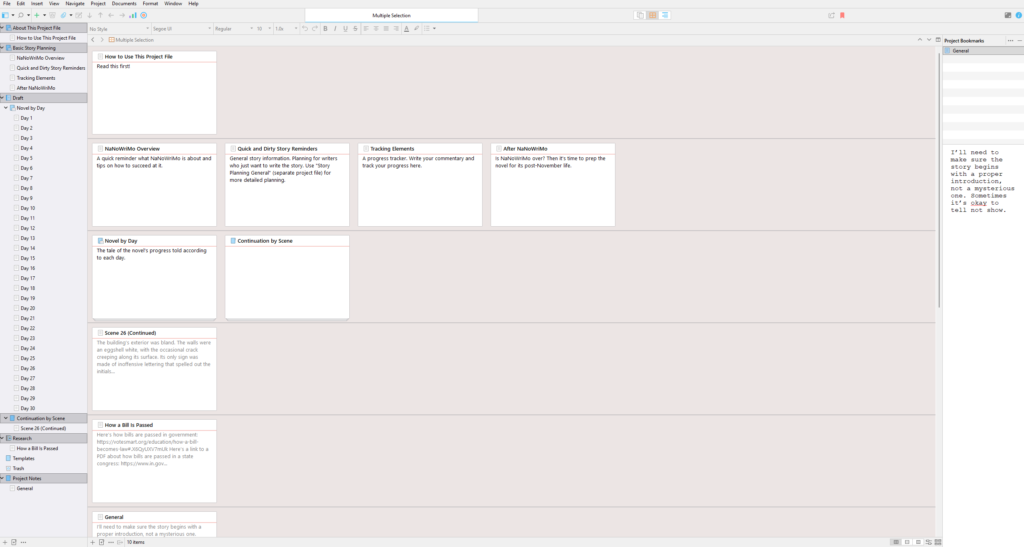
A software interface showing a project management view for a novel, with multiple document cards including story outlines, tracking elements, and writing notes.
Turning Up the Relevance Dial
This was certainly better, but now I realized that the template I was using was merely minimal and nothing more exciting or impressive than the NaNoWriMo templates I could download from other vendors, including Literature and Latte, the developers of Scrivener. So, by 2022, the year I started the first book in the In Times of Madness series, Revenge of the Innocent, I added a feature I probably wouldn’t use for myself, but I thought others with more focus and determination might find helpful: a social media tracker. This marked the beginning of using the template for writing that went beyond the novel itself, and by proxy, the beginning of the NaNoWriMo Basic Template as a central hub for story development and marketing, not just 30-day novel writing and word count tracking. This idea was extended with a new section for drafting and ranking ideas in case writers approached the November event without a premise to work with.
But these new additions, quite frankly, were of minimal importance when it came to the development of the actual novel. The issue remained: What do we do after Day 30? Was there a way to fix the work in progress without taking it into a new program? For that matter, what about works we’ve already started? NaNoWriMo seemed to focus on starting new works, but that was mainly due to how it was marketed. In reality, NaNoWriMo was always about finishing a novel, or getting the next 50,000 words toward finishing. That meant, in theory, NaNoWriMo could also be about continuing a novel already in progress.
So, in 2023, the year I started expanding my short story “Amusement” into a larger work called I Am Not Amused, I added two new composition features to the template: one for fixing the NaNoWriMo draft without exporting it or changing the words within the “day” structure, and one for establishing a new starting point from within a story already started. “Draft Corrections” and “Existing Sections” thus became essential additions to keeping the story within the same project file even if the work was nontraditional to the NaNoWriMo event window.
Now the template was beginning to feel like the place to go to draft the latest NaNoWriMo story, especially now that I’d also included a place to record our “win” status and resultant prizes for winning, but there were still limitations I wasn’t satisfied with.
For example, whenever I’d record my word count for the day on NaNoWriMo’s official site, I’d often wait until sometime between 11:50 and midnight to post it. This sometimes meant interrupting my workflow and shorting the scene in progress, so I could click the button that showed me my progress for the day, hop over to nanowrimo.org to record the day’s word count, and watch the graph shoot up, down, or stay the same, depending on my progress from the previous day. Then, once midnight passed, I could resume my progress on the next day’s file.
As you could imagine, this made tracking the story’s progress odd.
Now, I wouldn’t address the oddity of a broken scene until the next year, but for 2024, the year I returned to my Donald Peach series with a new first-in-series entry called The Double Annex Agency, I at least decided it was time to tackle the problem of waiting until midnight to post my word count progress.
“Session By Day” was born out of the idea that sometimes I’d like to update my word count after each writing session, not after each full day of writing. Since NaNoWriMo’s website permitted updating word counts as we progressed, not just once a day, I thought the NaNoWriMo Basic Template should do the same. So, I made a duplicate section within the “Draft” folder that allowed writers to write by session instead of by day. I’d also created a new journal section to supplement the “Tracking Elements” for those who wanted to journal and update progress as they went via the “Dedicated Daily Journal.” Because Scrivener has no internal logic that can turn off one path when another is activated, I had to write the caveat in the instructions that “Novel By Day” (the day plotter) and “Session By Day” (the session plotter) could not share scenes, as it would double that day’s word count in the project file. That meant I would need to be deliberate in how I chose to write that day.
I’d also added new developmental tools for characters, locations, objects, and conflicts to expand knowledge beyond what was reasonable in the “Quick and Dirty Story Reminders,” but I’d done it more for the dedicated planners who need a complete story development environment. I wasn’t sure if I’d ever use it myself, since the “Quick and Dirty Story Reminders” was sufficient for my use cases.
But going back to “Session By Day,” as much as I liked the idea behind it, I thought it had created a new problem to solve, if not highlighting an old problem, one that had frankly existed since the original 2019 Edition of the NaNoWriMo Basic Template. In short, as of 2025, scenes were still broken by progress and midnights, not by plot points and scene beats. So, for the update that I would use to draft a standalone idea I’d had on my ideas board for about ten years, Out for Milk (the one that would end up getting the least amount of words among all my works within the 30-day window at barely a thousand words, largely due to the overwhelming attention I had given to other projects that were backing up behind a very large dam), I had added a new section called “Chapter Compilation.” In this section, I could move all my content out of the day sessions and into an official assembly section where I could build a chapter or scene out of multiple days’ content. This section would exist outside of the “Draft” folder, so it would not affect word count tracking. It would also, in effect, eliminate the need to export the story into a new document or project file ahead of book production.
This meant, as of 2025, I finally had a complete NaNoWriMo Basic Template that could account for the story’s total development, from beginning to end, even into January or February if needed. And because I’d also added new sections for more detailed outlining, which included a page for importing outlines directly from Plottr, I figured I’d finally had the ultimate template for drafting a story for NaNoWriMo.
Except, in 2025, we no longer had NaNoWriMo.
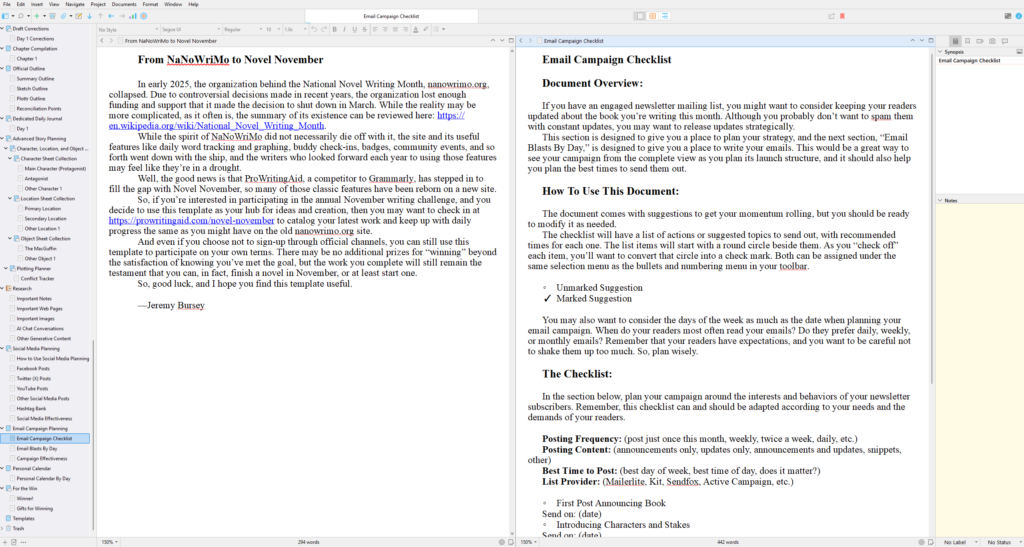
A split-screen view of a digital document titled “Email Campaign Checklist” showing text about NaNoWriMo, writing tips, and a list of email scheduling considerations.
The NaNoWriMo Scandal Effect
Due to a scandal that had broken out in March of 2025, the organizers of NaNoWriMo had decided to retire the site and disband the program. But fortunately, the good people at ProWritingAid recognized the loss this move would have on the writing community, especially considering that NaNoWriMo had been the origin story for a few widely popular novels, including Water for Elephants (2006) by Sara Gruen, The Night Circus (2011) by Erin Morgenstern, and parts 2, 3, and 4 of Wool (2011) by Hugh Howey, so they took the torch left behind by NaNoWriMo and created a new successor event called Novel November. This new event was essentially the old event with all the same documentation methods, sponsors, and prizes, but with a new name and new powerful organizers.
When I finally finished updating the NaNoWriMo Basic Template for the 2025 event, I had to decide whether to keep calling it the NaNoWriMo Basic Template or change its name to the Novel November Basic Template (which, to be fair, was no longer basic, given how many new features had been added since the truly basic 2019 and 2020 versions—well, since the 2019 version, as there was no 2020 version). After about three minutes of thought, I’d decided to keep the original name since that was the name the template was known by. Even though I could rebrand the title just as the event had been rebranded, the document was the same as the one I’d created for the old event, so I figured I’d just keep the name. If nothing else, the legacy of NaNoWriMo could endure a little longer.
By this point, I figured I’d added enough new features for story development and composition that I could return to implementing a few marketing features, so I’d added a new section for email communication with fans and newsletter subscribers. Again, I wasn’t certain how much I would rely on this feature for myself, but I thought it would be useful for someone, so I made sure it existed.
NaNoWriMo Basic Template (2026 Edition)
And that’s where I’d left it as of last year. And I should note that by this point, I was running out of ideas. I thought I’d included just about everything anyone could want in a complete story development tool such as this one. I’d certainly gotten it to the point where it no longer needed an export prior to the final layout draft (in a program designed for layouts, such as Atticus, Adobe InDesign, or Affinity Publisher, now called “Layout” in Affinity 3). So, of course, I’d make this year’s update, the year I plan to write another story from In Times of Madness (after Hurricane Rick, Nice and Legal, and Revenge of the Innocent), this time a late entry in the series and a book I’d originally had as a standalone piece about masking universal truths in a society that lives in the dark, and one I’ve been thinking about since 2006, called The Light Switch, yes, I’d make this year’s update the largest in the NaNoWriMo Basic Template’s history.
Just goes to show, I guess, that when we run out of ideas, we come up with even more ideas than are probably reasonable to implement.
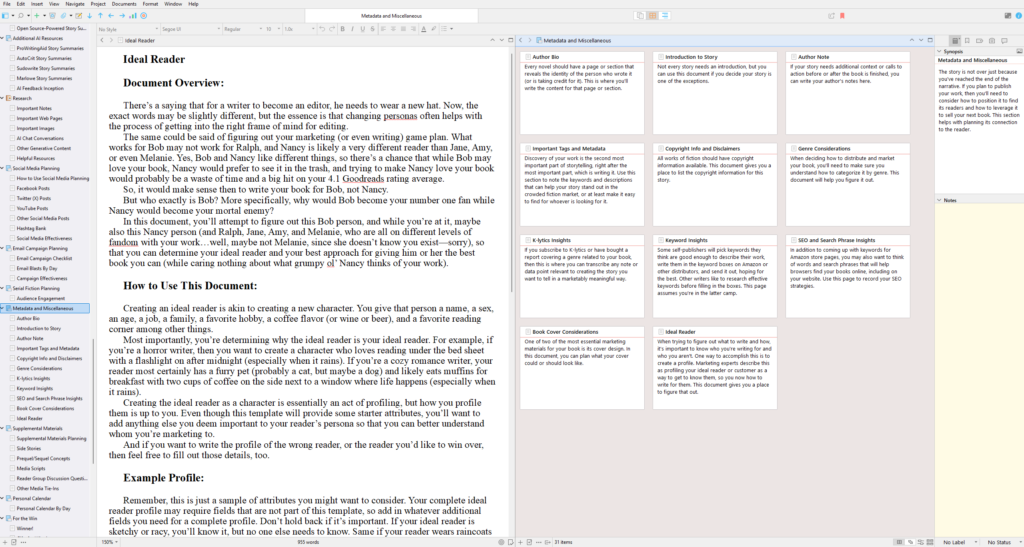
Now, I have no idea how users of this year’s update will apply the new features to their works. I’m not even sure for myself since I’ve done nothing yet but add the title and genre to the template. But as of this year, I can really ramp up my marketing and cataloging of the story if I want. And if I get reviews for the eventual release, then I’ll also have a place to report them. I also have new sections for reader feedback if my beta readers ever read their emails, and agent and editor feedback if I ever decide to shop my novel out to the professionals. And not to be outdone, I also now have a place to plan my supplemental materials, including side stories, prequels and sequels, in-universe text, art, music, etc., and whatever else I can think of to make the story world feel larger than what the book by itself can offer.
A digital document template titled “Metadata and Miscellaneous” showing an “Ideal Reader” section, with a sidebar listing various book metadata and marketing document categories.
Yes, this new version gives me far more opportunities to expand my work beyond its initial borders and really turn it into an event for readers. But my first job before I do anything else is to start writing on November 1st and see where that idea I’d come up with on a late night walk by the beach in downtown Delray Beach twenty years ago actually begins, and hopefully keep up with it throughout the Novel November event, and maybe have a secure foundation for it for the moment I make it my top focus.
And if you would like to have the same experience as I plan to have this year, you can download the 2026 Edition of the NaNoWriMo Basic Template for Scrivener (now for Novel November) right now.
Though, I should also mention that you’re no longer required to use Scrivener to use the template.
That’s the other major addition I’d brought to the template this year. I’ve finally exported every page into DOCX and RTF files, so you can use the template in Microsoft Word, Google Docs, or in whatever app allows you to upload these formats into their systems if you’d rather not bother with Scrivener this year.
And, well, that means I’m basically out of ideas, and given that I plan to take a break from NaNoWriMo/Novel November after this year (which will be my tenth), you can be sure the 2027 Edition next year will be even more epic, so make sure to keep watching this space, or my sister blogging site Drinking Cafe Latte at 1pm, or my newsletter (join here), or my YouTube channel (subscribe here) for the latest news and updates.
Also, if you want to see the latest update in action, be sure to watch the video below.



0 Comments