


Button Interaction Color Code: New Page Pop-up Window External Website Scroll to Section Inactive Link

The following articles take a look back at Heart of the OHR 2014 from the benefit of hindsight. The theme this year was accommodation. Regardless of the likelihood of a game doing well or poorly, this year was designed to help each game shine and form its own distinct identity.
The Two-Thirds Rule:
A New Way to Calculate Votes
A contest is successful based on two parameters: its participants and its scoring measurements. If every entry is garbage, then the contest is garbage. If every entry is amazing, then the contest can still be garbage if no one scores the winners. After all, what’s the point in having a contest if there are no scores? But if everyone scores, then the contest works and everyone wins!*
But how should everyone score?
The concept of scoring seems simple enough. Give value to the entry based on its quality. Or how much you like it. Or how much you think it deserves. Or how well it meets particular factors only you know about. Or how much you stand to gain by having it top out at a certain position. Or…okay, maybe not that last one (*wink*), but you get the point. Scoring isn’t actually so easy when the values are subjective.
But we still try because a good contest needs a good scoring system.
Scoring a Dartboard (Photo Credit: 41330, Pixabay)
Heart of the OHR has always been a contest that seeks the fairest outcome for its participants and players alike. Where most OHR contests depend on voters playing every game and ranking their favorites, which inevitably ends with some games getting the shaft or some contests getting no participants or voters, Heart of the OHR depends on voters scoring each game based on his or her experience, using a scale from 1 to 10 to represent his enjoyment factor. The benefit of scoring this way is that Heart of the OHR can find its winners based on average score, not ranking, which means that not every voter has to play every game (even if it’s still encouraged). This increases engagement and fairness among voters.
Except, in 2010 and 2012, not every game got a fair voter turnout. In 2010, for example, Vikings of Midgard got five votes, whereas the top voted game (Eternity Fragment Prelude) got twelve. In theory, there’s nothing wrong with such a player gap, as the voices of five voters are as important to the game as the voices of twelve. The problem arose, however, when Vikings of Midgard stole second place from Do You Want to Be a Hero? at the last possible minute because the person casting that final vote for Do You Want to Be a Hero? didn’t cast one for Vikings, making DYWTBAH’s final average score (via seven voters) slip just below Vikings of Midgard’s average score.
Clearly something was wrong here. More people played and voted on Do You Want to Be a Hero, and six of those people had kept it in second place. But the seventh voter helped earn Vikings of Midgard one of its more memorable achievements, “Mogri Shanker,” by not voting for it, and the rest is Heart of the OHR history.
Oops, Slipping on a Banana Peel (Photo Credit: stevepb, Pixabay)
I always knew that scoring by averages came with a potential flaw when I implemented it as the official voting system for Heart of the OHR. I just didn’t think it would appear so early in the contest’s legacy. Instead of making a change to the scoring system for 2012, however, I changed the way games were entered. Rather than grouping everything together in a solo contest, I created two separate voting blocks, Original and Re-released games. I did this because the original games had far more votes than the re-releases, and I figured it would keep things fairer if the margins were tighter. But everyone hated the split, so in 2014, I had to finally address the scoring issue.
My solution for fairness was to implement a system called “the two-thirds rule.” According to this rule, any game that failed to receive at least two-thirds the voter turnout as the top-voted game would get a middling series of fives for as many voter slots as it took to reach that two-thirds margin. So, if the top voted game received twelve scores and the lowest received five, then the least voted-on game would need exactly average scores of 5 in three slots to meet the two-thirds quota. It seemed like a fair way to balance the lack of audience impressions.
Of course, because no scoring rule is perfect, the two-thirds rule often had the effect of raising the average score for bad games (see Dragons!) and lowering the average score for good ones (see T4R4D1DDL3). In the case of T4R4D1DDL3, this balancing of the averages had cost it the season win, giving it instead to Winged Realm, previously in fifth place.
Not exactly a shining achievement for the two-thirds rule when it’s directly responsible for stealing the win from a game deserving of that win. Then again, T4R4D1DDL3 was unofficially entered, so it also probably saved me the headache of trying to contact the winner when he didn’t even know he was in the contest.
But regardless of how contestants and voters felt about the two-thirds rule, or scoring averages in general, that’s the system that Heart of the OHR has adopted ever since, and if the contest should ever make a return, scoring averages and the two-thirds rule will return with it. That would also include the unwritten and unspoken “one-third rule,” where a game has to earn at least one-third the top voter count to be eligible for the contest. To date, only one game failed to meet that requirement, and it’s one no one ever really wanted to play, which is obvious given the result.**
*Not everyone wins. Only the winner wins. Everyone else just benefits. The winner also benefits. Clearly.
**Fruity Quest (2016).

Two-thirds voting (Photo Credit: cottonbro, Pexels)
In the Spirit of 1999
Until 2014, a participant in Heart of the OHR had to present an RPG as an entry. As much as I had a habit of bending the rules each season to allow an outlier to join, there was just no bending that rule. If the game wasn’t an RPG, then it couldn’t enter. Period.
But then TMC, one of the OHR’s top developers, brought up an interesting talking point. Was the “heart” of the OHR rooted in just RPGs, or was it rooted in the experience of using the OHR as a game design tool for creating any type of world possible under the limitations of the engine? His argument was that some games were just walking and talking adventures, not battlers. To defend his argument, he referenced the engine’s earliest games (circa 1997–2001). While RPGs were certainly the genre of choice for most OHR users of the early era, some people created simple exploration games similar to what we might call a “walking simulator” today. And those, too, were part of the “heart” of the OHR.
He made his point when advocating for T4R4D1DDL3 as an entry. Even though the game’s author hadn’t himself volunteered to enter, TMC thought T4R4D1DDL3 should’ve been part of the contest because it embodied the spirit of what OHR authors used to make back when the engine was still young and wild.
It didn’t take long or much effort for me to see his point. T4R4D1DDL3 captured what I’d refer to as “the spirit of 1999,” which essentially meant that it embodied the types of games we saw early on in the OHR’s life cycle, and to exclude it would’ve been like excluding the “heart” of the OHR itself. Even if it wasn’t a true RPG, it was by all intents and purposes a true OHR game, built from its rawest features. To deny it would’ve been unfair to T4R4D1DDL3 and games like it.
So, I allowed it to enter.
But then the snowball started rolling.

Frozen soap bubble (Photo Credit: JordanHoliday, Pixabay)
Allowing T4R4D1DDL3 into the contest created a slippery slope that the Heart of the OHR had never recovered from. What qualified as an RPG or “in the spirit of 1999” became muddier and muddier with each passing season. By 2020, I was permitting the very types of games that Heart of the OHR was designed to discourage, all because the lines were blurry enough to justify their entry, because I had already made enough contingencies in seasons past to accommodate them. It just took a single modification to the rules to create the snowball and the hill it rolled down.
It’s in some effect why the Heart of the OHR no longer works as a contest. The “heart” has been lost under all the “updates” to the rules. Then again, the engine itself has changed so much in 23 years that it barely represents its early self, making any OHR game relevant to today’s “heart” of the OHR.
Perhaps the contest is exactly what it needs to be, and the “spirit of 1999” is equal to the “spirit of 2014,” which is equal to the “spirit of 2021.” Maybe Heart of the OHR was just using nostalgia to ignore the engine’s obvious evolution.
Deep down, I think that’s the real reason I kept bending the rules for games that didn’t naturally qualify. In some way, they did qualify, just not under the rules of nostalgia.

Flashback to 1999
The Prestigious WTF Award
When I assembled the first end-of-contest report for Heart of the OHR 2010, I had this wacky idea to present not only scores and voter trends, but also “fuzzy descriptions,” “audience consensuses,” and most ambitious of all, “achievements” for each game. I’m not quite sure what prompted me to do this, but it seemed like the perfect opportunity to add more life to a series of contest games that had already earned their places in the final results. Perhaps because the achievements concept was gaining momentum on Steam and Xbox Live, and certain games were already adding them internally, I thought it might be worth it to try it here, too. So I did.
Funny enough, the idea was well received.
“Whose idea was it to include ACHIEVEMENTS for voting results great gravy, that's brilliant”
–Baconlabs, (via “HamsterSpeak 45 Online” Thread on Slime Salad, January 3, 2011)
Of course, because all achievements were new in 2010, I didn’t yet know which ones would be unique and which ones would recur, but as the seasons came and went, some achievements made a triumphant return, so I thought I’d highlight a few of them here to cement their significance to Heart of the OHR.
Note: I’ll be listing them according to frequency and impact, as well as keeping similar achievement types grouped together for relevance.
Candidate for Best of 20##
Even though the OHR was a hotbed of activity from 1998–2007, production on games seemed to decline each year, until only the contests produced the majority of releases we’d see. By the time Heart of the OHR entered the scene in 2010, independently released games were few, and the odds of a game getting any release depended almost entirely on whether it was tied to a contest. This meant that one of the perks to becoming the winner of the Heart of the OHR was that also becoming “Game of the Year” was practically inevitable. This was certainly true for 2010’s winner, Motrya.
That said, winning Heart of the OHR was only part of the condition for winning the “Best of” achievement. The game also had to score an average of 8.0 or higher. Anything less, and the contest lacked the quality of the annual average, and a top achieving game wouldn’t necessarily equal most memorable of the year. That’s why some Heart of the OHR winners didn’t earn this award while others did.
Most/Least Voted On
Another guarantee of any OHR contest, especially Heart of the OHR, is that some games will attract most of the attention from players while others will gain very little of it. Contests where ranking is required will likely get more voters rating more games, even if half-heartedly, but Heart of the OHR anticipates voter selection by requiring a scaled score, offering players an out if time or conscience comes against them.
Historically, players have been good about playing the “hot” games like Motrya or Kaiju Big Battel: Fighto Fantasy, and they’ve been good about playing through the original releases. But many times, especially in the early days, they’ve been less prone to play through re-releases, and even less willing to offer a rating when it’s unclear which parts are new for the contest. Likewise, players who play a game they believe violates a contest rule (too short or “not RPG enough” are the top violations) may abstain from offering it a score (even though it’s an approved entry). And, of course, some players who also participate as entrants may decide not to rate their own games, even though the contest both permits and encourages this practice as the final score may skew negatively against them if they don’t, especially with the two-thirds rule in place.
For these reasons, voter turnout has rarely been consistent across all games, and because of that, I wanted to include a seasonal achievement that highlights the most and least voted-on games. Even though the contest is weighted on the score value and ultimately determines its winner according to highest average score, it’s nice to know which games are the most and least popular among players, especially when the second place game gets the fewest unique voters (Vikings of Midgard, 2010 release). Does the score even matter if so few have played it?
Waist Level Champion (and Below the Belt Champion, Below the Knees Champion, and Chest Level Champion)
One of the things that sets Heart of the OHR apart from other contests is its rating system. Where other contests require comparison ranking to determine winners, Heart of the OHR requires scoring on a scale from 1 to 10. So far, this system has garnered little controversy and reasonably accurate impressions of a game’s quality. By itself, it’s just a bank of numbers boiling down to a single average, and the average is all that the end user will ever see.
But statistics are part of the fun of learning about a game’s reputation among players, and the contest’s high-low values tell a more nuanced story of just how well a game is received. For example, a game that averages 4.2 among twelve voters may sound like a below average game. The three people who score it a 2 certainly think it’s way below average. But what about the person who gave it a 7? To that voter, the game is pretty darn good, not just average, and certainly not below average. Is an average score of 4.2 really representative of every player’s perspective?
While the average score is designed to place a game within a contest’s ranking system, it does not represent the view of every voter, so I thought it was important to include the highest and lowest ratings of each game to show its potential on either side.
Note: On the statistics page, I may offer even more insights into a game’s true performance, including mode and median scores. Stay tuned.
To better represent the true appeal or revulsion a game offers to players, I’ve included achievements based on scoring ranges that represent positions on the body. These achievements include:
Below the Knees Champion: Game receives no score above 3.
Below the Belt Champion: Game receives no score above 4.
Waist Level Champion: Game receives no score above 5.
Chest Level Champion; Inflated Chest: Game receives no score below 7.
Note: Kaiju Big Battel: Fighto Fantasy (2018) had never officially received a “Chest Level Champion” or “Inflated Chest” achievement because it had already gotten 15 other achievements when I usually cap out at nine, but it was certainly deserving of it, and if I were to add new achievements to old games, it would certainly earn it this time.
You’ll note that I never established an achievement for games that score a minimum or maximum of 6. That’s largely because games with a minimum score of 4–6 or maximum of 6 are so common that to offer them all achievements would be overkill. Retroactively, I’d award them an “Above the Waist Champion” achievement if their rating situations were a rarity.
Likewise, because no game had ever ended with a high score of 2 or a low score of 8 or higher, I never had the need to create special achievements for those situations. But if I had, they’d look like this:
Bottom Feeder; Spider Eyes: Games that score straight 1’s would likely get one of these two achievements (or something similar).
Feet Level Champion; Below the Ankles Champion: For games with a high score of 2.
Neck Level Champion: For games with a low score of 8.
Head Level Champion; Above the Fold: For games with a low score of 9.
Elysian Resident: For games with a perfect 10 across the board.
It’s probably good that none of these unused achievements ever saw the light of day because the low end winners would depress their authors (likely) and the high end winners would give their authors a fat head (possibly), but it’s still nice to know what’s possible should Heart of the OHR continue past 2020 or return at another time.
Fun Fact: “Waist Level Champion” is the first achievement ever issued in this contest. It was given to ncw64’s Hero (2010) for having, well, a high score of 5.
Working 9 to 5 (and others)
Like the “Waist Level Champion” style achievements representing the extremes of voter trends, I also have achievements for high-low scores representing numerical codes or jargon.
For example, office and professional type achievements, such as “Working 9 to 5,” “Banker,” and others represent any game that draws a high score of 9 and a low score of 5, in honor of the traditional workday schedule.
Likewise, communication achievements like “Good Buddy” and “Over and Out” represent any game that has a high score of 10 and low score of 4.
These achievements that play on numbers add to the lore of Heart of the OHR because they are based not on the games themselves, but on the players’ response to them, and I think any contest that includes achievements should also recognize the players, not the just the authors or game content.
Fan Favorite (and Audience Favorite)
As I mentioned earlier, just like Rotten Tomatoes’s and Steam’s average score system (which works just like Rotten Tomatoes’s positive-negative system), the overall score does not always accurately reflect the user’s enjoyment of a game. It just takes the sum total of the grand user experience and boils it down to a concrete number. For this reason, a single low score can bring down the average of a game with predominantly high scores. If this gash out of the average high score is significant enough, it can cost a game its high, if not winning position within the contest.
Several times throughout the Heart of the OHR’s lifespan, this situation has occurred, and games with high praise still end up coming in second place or worse.
For this reason, I wanted to issue a special achievement to any game that scored predominantly high marks among most users, but failed to win simply because it missed the mark with one or two players (usually due to mismatched genre preference or outright spite for the game or its creator).
That achievement, “Fan Favorite” (or “Audience Favorite,” in the case of 2020’s achievement winner), reflects the “spiritual winner” of the contest, even if the numbers go to someone else. This award can be given to games with not only mostly high scores (6 and above), but also to those that are praised incessantly on the message boards.
So, even if a game comes in second, third, fourth, or worse, any game that has the “Fan Favorite” or “Audience Favorite” achievement has clearly won, as far as the majority of players are concerned (and probably would’ve actually won, had the contest been based on comparative ranking).
Mogri Shanker (and others)
Similar to “Fan Favorite,” some achievements reflect the “shanking” of a game’s high position because of a single last-minute vote for, or abstention from, another game that ends up taking its spot. Most notably, this achievement began with “Mogri Shanker,” which reflects that one time in 2010 when Vikings of Midgard (by Fenrir-Lunaris) stole second place from Do You Want to Be a Hero? (by Mogri, hence the achievement name) when players chose to abstain from voting on Vikings due to an unwillingness to find out what was new about it. This became solidified when the last voter’s final vote moved Do You Want to Be a Hero? back one position after he gave it a value (slightly lower than its going average) but abstained from voting for Vikings of Midgard, thus affecting the final score in favor of Vikings taking second (when it previously ranked lower). This “shanking” is also the reason I implemented a two-thirds voting rule later in the contest’s lifespan.
Similar achievements can be found throughout the contest, including most recently in 2020, with the shanked game’s respective author taking Mogri’s place.
Winner of the Prestigious WTF Award
So far, games have received achievements based on performance with players, but I also thought they should receive special achievements for content. Whether the game effects a theme, an idea, or a particular gameplay moment, any element can earn a special achievement, and those special achievements are almost always exclusive to that game. For example, in 2014, Dragons! by Guroo (an unofficial entrant, by the way) earned an achievement called “Where Are All the Dragons?” because its lack of in-game dragons betrays the promise of its title. This achievement is very specific and would never work for a game that didn’t have “Dragons” in the title.
But some games have aesthetics or themes that can be passed on to other games, and one such theme is the “weird game,” or the one that defies all expected conventions.
AR-PUH-GUH! by Meowskivich was the first Heart of the OHR entry to introduce us to this concept of the unconventional game. But it wouldn’t be the last. In 2012, it won what should’ve been a one-and-done award, “Winner of the Prestigious WTF Award.” But in 2014, another game, T4R4D1DDl3, came along and produced much of the same response in me and in other players. It was an odd game that left many players scratching their heads.
At that point, it became clear to me that the “Winner of the Prestigious WTF Award” would not be isolated to one game in 2012, but given to any season’s “weirdest” entry, and for the most part, each season following 2014 has had at least one game deserving that returning achievement.
Mechanical Heart (and Poisoned Heart, Challenged Heart, and True Heart)
Heart of the OHR was founded on a simple principle: Make and release an RPG that reflects the purpose the OHRRPGCE was designed for. This generally translates to a full-length quest with role-playing elements, stat growth through battles (mostly random), and multiple and diverse character rosters. About 90% of the games released during the contest window will adhere to this basic principle without controversy or challenge.
That leaves about 10% to create a wake of unrest among players, the contest rules, and the OHR’s legacy. That percentage could be off a few points in either direction, depending on how we define these controversies.
Because Heart of the OHR is ultimately a flexible contest, I wanted to create achievements based on the embedded challenges that come with accepting nonstandard entries, to show that the rules are closer to guidelines than unbendable instructions. This series of achievements became the “Altered Heart” collection.
In 2012, a game called Silhouette earned the first “Altered Heart” achievement, called “Mechanical Heart,” for resembling an RPG while playing like a puzzle game. It demonstrated the look of a random battle while employing a fixed numbers system for battles that produce the same outcome every time. In 2014, a game called James Doppler… earned the achievement “Poisoned Heart,” which emphasizes the abusive NSFW heights that some games can reach when standards are low and acceptance is high, two things of which the game accomplished with little effort. These achievements have since made returns in later seasons, along with unique-so-far achievements “Challenged Heart” and “True Heart” to show that the “Standard Heart” is in no way alone on this stage.
Any game that earns these achievements aren’t necessarily outliers, nor are they outcasts. They’re just games that explore nonstandard conventions to tell their RPG stories, and these achievements recognize them for that.
8-Bit Hero (and Palette Hero and variations)
Whenever we make a game, we have to make aesthetic decisions about how to tell the story. In most cases, we’ll draw some tiles, find some music, and mix everything together for an adventure that meets our “style,” whatever that is.
But other times we’ll adopt a popular style convention, like anime, black-and-white, or 8-bit to develop our game ideas. When that style works, the game will demonstrate a cohesive aesthetic that can trigger the player’s nostalgia. Or, it can create a new effect that promotes the mood of the game (similar to how the abundance of yellow, blue, and purple lighting can affect the mood produced in a cyberpunk game).
Once again, Heart of the OHR wants to recognize certain games that adhere to a particular aesthetic, and the most celebrated of those aesthetics is the 8-bit game, thus the awards for “8-Bit Hero” and “8-Bit Palette Hero” are given to any game that handles that graphical standard well.
Saturday Morning Special
Similar to “8-Bit Hero,” any game that captures the look and feel of a Saturday morning cartoon (or the types of cartoons that used to air on Saturday morning back in the 1980s and 1990s) earns the award for “Saturday Morning Special.” It’s an award that credits thoughtful art design and presentation while capturing the mood and whimsy fostered in a classic children’s cartoon. Any game that earns this award deserves special recognition for its graphics decisions and implementation, not to mention the visual joy it brings to the player.
My Shizuma
Another type of award that credits RPGs for their thoughtful use of 8-bit graphics and consistent palettes, but goes a step further in also recognizing their dedication to the traditional RPG format recognized in classic NES-era games Dragon Warrior and Final Fantasy. The achievement is based on the work of Shizuma, lead designer of the OHR classic Spellshard: The Black Crown of Horgoth, which systematically replicates everything great about those old classic NES RPGs.
Prettiest Sadness
Although rare as far as returning achievements go, the “Prettiest Sadness” award is a rising prestige award for graphical style, in the vein of “8-Bit Hero” and “Saturday Morning Special.” It represents any game that depresses the mood while doing so “beautifully.” The art will usually reflect gray or dark colors, but will do so with meticulous detail and consistent style. It will often pair with gothic or apocalyptic games that take the time to get the art and aesthetic right.
Fan Game Award
Another interesting component to the reason behind Heart of the OHR is that prior to 2010, too many authors were releasing joke games into the community. While there’s nothing wrong with that per se, it started becoming annoying when the joke game (or the tech demo) was all we’d get from authors. The days of the quality RPG were declining.
Also declining were the days of the original quality RPG. If we weren’t getting half-baked joke games or unfinished tech demos, we were getting games based on someone else’s IP (usually Dragon Ball Z or some other anime title). Not always, obviously, but enough.
For this reason, Heart of the OHR discouraged the release of fan games. It likes original content, or content that completes an earlier release. But it didn’t disqualify them. And because it didn’t disqualify them, fan games ultimately appeared in the competition (with two of them winning their respective contest seasons).
This achievement recognizes them as not only “fan games” but quality fan games. One of the blights on the traditional OHR fan game was its low quality representation of the source material, but games with this achievement elevate that source material (and the OHR along with it).
Note: Like “Chest Level Champion,” Kaiju Big Battel: Fighto Fantasy (2018) could’ve won this award if it hadn’t already won 15 others.
The Big Empty (and Most Expansive Nothing)
Another staple award given to games with a very particular design choice. “The Big Empty” is a love bite for any game that employs huge spaces with very little interaction or sights to see within them. It’s the type of design choice often made by newbies who don’t know better or designers who know better and have big ideas to fill in later. Or, in the case of my own games (like The Adventures of Powerstick Man in particular) want the maps to reflect a little realism according to their locations (a large field connecting two regions isn’t normally full of interesting things). But “The Big Empty” wasn’t its first name. This award was originally called “Most Expansive Nothing” when it was awarded to Master K’s Illusions (2012) for employing the same tactic. It became “The Big Empty” in 2014 for Mr. Triangle’s Adventure and held to that name ever since.
It should be noted that winning “The Big Empty” doesn’t mean the game is boring. Even though Illusions came in tenth out of thirteen for its year, Mr. Triangle’s Adventure came in fourth out of twelve for its year, so the award is given more as a point of acknowledgment, not as a knock on its quality.
Most Ambitious/Spirited/Ridiculous/etc.
Finally, we have the superlative awards “Most Ambitious,” “Most Spirited,” “Most Ridiculous,” and so on. These awards are exactly as they’re defined: crediting a game for being the “most something” of its class.
These awards exist to keep the achievements system from being too ambiguous or too random. If a game is considered the “most ambitious,” then it probably goes above and beyond conventional expectations, more so than any other title in that year’s contest. If it’s the “most ridiculous,” then it probably goes out of its way to stand out as absurd.
These superlatives try to be positive, or at least affectionate (hence “Most Ridiculous”), so there won’t be an achievement called “Most Stupid” or “Most Useless.” But because these superlatives are conditional on the games, the seasons, and the achievement’s situation (remember, I like to cap them at nine per game, except for the winner), there’s no particular formula that determines which game gets which “most” achievement, or even which category will get an issue that year. Where the usual staples like “Winner of the Prestigious WTF Award” are intentionally given (as in, which game best deserves it this year), the superlatives are anecdotally given, and there’s no real call for a particular superlative in any given year.
So, the superlatives really are based on occasion. But they certainly add notoriety to the games they’re attached to.
In Conclusion
So, that’s generally how the achievements system works for Heart of the OHR. If the contest should ever make a return in the 2020s, then this system will continue, as will these special achievements.
Will your game be worthy of the Prestigious WTF Award?

Winner of everything (Photo Credit: RODNAE Productions, Pexels)
Joker’s Breakout
and the Re-release Flaw
When I started Heart of the OHR, I wanted to allow currently existing games to enter with re-released content. The purpose was to promote the completion of a title, especially those beloved by players. In 2010, Fenrir-Lunaris heeded the call by submitting an updated version of Vikings of Midgard. But no one knew exactly what was new about it, so most didn’t play it, or at least vote on whatever they did play.
In 2014, the curse of the re-release came back to haunt Heart of the OHR when RedMaverickZero released an expansion to his Batman & Robin fan game called “Joker’s Breakout” and very few people played far enough into the game to unlock it.
The ironic thing was that no one knew how to identify Vikings of Midgard’s new content because it was all over the place. But Batman & Robin’s new content was loaded fully into the expansion. There was no question what was new here. Yet, getting to that point required playing the base game all the way through, and that was apparently too much to ask of some players.
This caused me to revisit the question: Is it even worth it to allow re-releases into the contest? If no one bothered to play the new content, then how could they justify their scores? How could they even give it a score? The fact was, the re-release flaw of 2010–2014 was that voters just voted on old content, which was antithetical to the motivation for releasing new content for an old game into the Heart of the OHR. It didn’t seem fair to those who wanted to finish their long-in-development games.
Maybe the flaw was in the community’s size. At any one time, the community has maybe a dozen active members and a few more lurkers. Of these members and lurkers, just a dozen typically play and vote. This makes for a very low completion threshold of any game, especially those that players have played before once upon a time.
Nevertheless, I still allowed the zombification of old releases because they tended to petrify otherwise. I don’t suppose anyone would’ve played “Joker’s Breakout” if not for Heart of the OHR. I’m not convinced it would even exist if not for Heart of the OHR.
The fact that the players who did play “Joker’s Breakout” complained that it was too linear compared to its source game is another discussion entirely, one I’m not going to have right now. But at least it was new content. New content that few people played.

The expansion (Photo Credit: geralt, Pixabay)
A Former Results Host Returns
The original Heart of the OHR’s results were hosted on the community magazine site HamsterSpeak in early 2011. When I announced Heart of the OHR 2012, I’d expected to present the results in the February 2013 issue. But the magazine closed before that opportunity could come. So I had to find a new host. That’s when TheCube offered to host the results at his new blog site, The Hamster Burrow.
The Hamster Burrow did a nice job preserving the integrity of the Heart of the OHR 2012 end-of-contest report, which used the same format as the 2010 report, and I’d expected that maybe I could send the 2014 results there for hosting once the time became relevant. But then The Hamster Burrow closed, too.
That meant finding a new host for 2014. And that meant more asking around for help. Begging people to host my contest results because I didn’t have a site of my own had never been a thing I enjoyed. Yet, here I was doing it again.
Fortunately, The Wobbler, former host of HamsterSpeak, agreed to set up a page on Super Walrus Land, home of HamsterSpeak, for the Heart of the OHR 2014 results, retaining the look of the original, and solidifying the Heart of the OHR brand. Posting the results there was a bit like resurrecting HamsterSpeak for a limited time, even if HamsterSpeak had nothing to do with the contest anymore. Double fortunately, I was able to keep some consistency between contests when The Wobbler hosted the 2016 results, too. Of course, by 2018, I had to find a new host because The Wobbler became a contestant again and understandably didn’t want the conflict of interest. But if I could find a host for 2014 and 2016, then I was certain I’d eventually find one for 2018.
More about that in the 2018 article section.
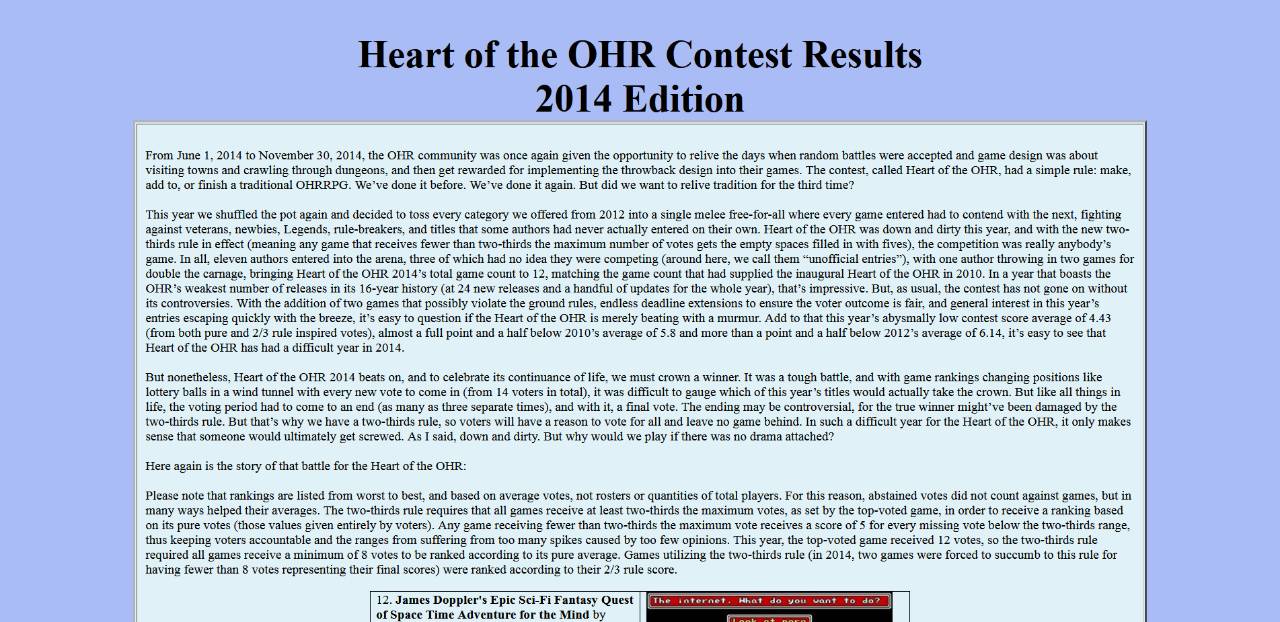
Screenshot of the original 2014 results at Super Walrus Land.

Thanks for taking this trip down memory lane with me. Hope you enjoyed it. Don’t forget, you can always view the original announcement threads for this and other Heart of the OHR contest seasons by clicking on their respective links below.
You can also jump to the next season’s contest page series by clicking on the button below. There, you’ll find even more nuggets into the life and times of Heart of the OHR. Hope you’ll check it out.
Finally, I want to offer a special thanks to everyone who participated in each Heart of the OHR contest season. It goes without saying, but I’m going to say it anyway, this contest could not exist without you. Obviously. So, thank you for making it possible if you were one of the participants. I also want to thank the prize holders for volunteering their gifts and services, as well as the voters who gave up their time to play these games. This contest was among the most successful contests of the 2010s because of your participation. It came back every even-numbered year because I knew you’d come back, too. So, thanks again for making Heart of the OHR such a special event each time.
I hope that whatever replaces it in the 2020s will be just as special.
